7 Signs Your Engineering Project Management Software Isn’t Built for Complex Projects
Most engineering firms don’t suddenly discover that their project management software is bad. More often, the organization, portfolio, and complexity of delivery have simply outgrown what the system was originally designed to manage.
A platform that worked perfectly well for a smaller organization or a relatively consistent portfolio can begin to struggle when it is expected to support multi-million-dollar projects, multiple delivery models, joint ventures, increasingly sophisticated project controls, and thousands of simultaneous activities.
The warning signs usually appear gradually.
Project teams build spreadsheets to fill gaps. Reporting takes longer. Forecasts become harder to reconcile. Project Controls spends more time validating data than analyzing it. And senior leadership begins asking why the information they are receiving describes what happened several weeks ago rather than what requires attention today.
For Project Controls Directors, VPs of Project Delivery, PMO leaders, and others responsible for project performance, these are not simply software inconveniences. They can become execution risks.
Here are seven signs that your engineering project management software may no longer be keeping pace with the complexity of your projects.
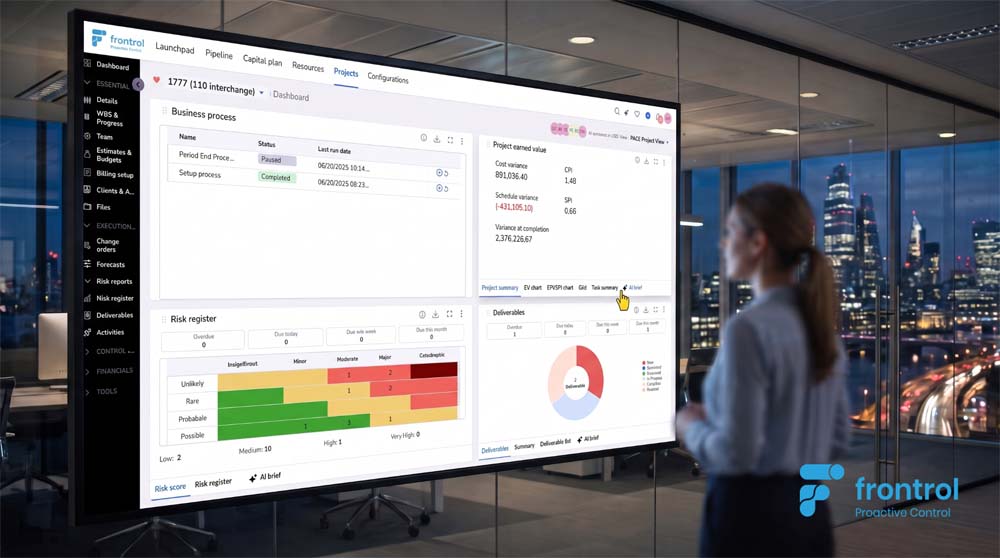
Frontrol built PACE as a project delivery execution and controls platform designed for complex, project-driven organizations.
Rather than asking project teams to become the integration layer between disconnected systems, PACE connects schedule, cost, progress, forecast, risk, and change into a common execution environment.
That connected model provides project teams with current visibility into performance while giving leadership the ability to move from portfolio-level indicators into the projects and underlying information driving them.
PACE is designed to support multiple delivery models — including EPC, design-build, and internally delivered projects — without forcing every project into exactly the same operating process.
Its AI capabilities work with connected execution data to help identify emerging project signals rather than relying solely on static reports and disconnected exports.
The result is not simply another place to store project information.
It is an environment designed around real-time visibility, proactive control, and collaborative execution.
Want to see how PACE fits your portfolio? Request a live demo, and we’ll walk through it using the kind of complexity you’re actually managing.
1. Connected Cost, Schedule, and Progress
Knowing how a project performed last month matters. However, knowing where performance appears to be heading matters more. Traditional project reporting generally follows a familiar sequence:
Data is collected.
The data is validated.
Reports are prepared.
The information is distributed.
Leadership reviews it.
The project team decides what action may be required.
The problem is that project conditions continue changing throughout that process. By the time everyone is looking at the same numbers, the situation that created the variance may already have moved on.
That creates a critical gap between reporting and intervention.
A platform designed for complex project delivery should help teams identify where attention may be required while there is still time to influence the outcome.
That might mean recognizing:
- CPI deteriorating across several reporting periods
- schedule variance widening on critical or near-critical activities
- labor productivity trending below plan
- ETC increasing faster than physical progress
- unresolved change accumulating against the contract
- risk exposure increasing in a critical work package
- forecast margin beginning to erode
Traditional reporting can tell you that a variance occurred.
Proactive project controls should help you understand what is changing, why it matters, and where the project team should investigate next.
This is also where AI can become genuinely valuable in project delivery.
AI should not simply provide another chatbot sitting above disconnected project information. Its value increases significantly when it can work with live execution data and recognize emerging relationships among cost, schedule, forecast, risk, change, and performance.
That is why PACE AI operates directly on connected project execution data — helping teams move beyond static reporting toward earlier identification of emerging project signals.
The goal is not simply better reporting. It is to shorten the distance between visibility, insight, and action.
2. Forecasting Depth
Many platforms can display budget versus actual cost. That does not make them a project controls platform.
A capable solution should support forward-looking forecasting, including:
- Bottom-up Estimate to Complete development
- Estimate at Completion calculations
- Time-phased cost forecasts
- Cash-flow forecasting
- Forecast versions and comparisons
- Forecast assumptions
- Remaining duration and resource requirements
- Trend analysis
- Contingency analysis
Project controls should help teams understand where the project is heading, not simply report where the money has already been spent.
Buyers should ask vendors to demonstrate how project managers update forecasts, how assumptions are documented, and how changes to cost or schedule expectations are reviewed and approved.
3. Performance Measurement and Earned Value Management
Earned Value Management is one of the most established methods for measuring integrated cost and schedule performance.
A capable platform should support key measures such as:
- Planned Value
- Earned Value
- Actual Cost
- Cost Performance Index
- Schedule Performance Index
- Estimate to Complete
- Estimate at Completion
- Cost Variance
- Schedule Variance
- To-Complete Performance Index
Together, these measures show not only how much has been spent, but how much value has been delivered for that expenditure.
For example, assume a project planned to complete $1 million of work by the reporting date. The project has spent $950,000 but completed only $800,000 of planned value.
A conventional budget report may suggest that spending is below plan. Earned Value Management reveals a different picture:
- CPI = $800,000 ÷ $950,000 = 0.84
- SPI = $800,000 ÷ $1,000,000 = 0.80
The project is earning only $0.84 of value for every dollar spent and has completed only 80% of the work planned for the period.
Even organizations that do not operate a formal EVM program should expect their project controls platform to connect baseline plans, actual costs, physical progress, and forecasts.
Without that connection, project performance metrics can quickly become historical reports rather than early-warning indicators.
4. Risk, Issue, and Change Integration
Risk, issue, and change management should not operate independently from cost and schedule control.
Buyers should evaluate whether the platform can:
- Quantify cost and schedule exposure
- Link risks to affected work packages or milestones
- Convert realized risks into issues or changes
- Track potential and approved changes
- Assess change impacts
- Update contingency requirements
- Support governance and approvals
- Reflect approved impacts in forecasts and baselines
A risk register that is disconnected from the project forecast provides only limited value.
The same applies to change management. A platform should help teams understand how a proposed or approved change affects cost, schedule, resource requirements, contractual commitments, and expected project outcomes.
5.Portfolio and Program Visibility
Project controls software should support decisions at more than one organizational level. Executives and PMO leaders need to understand performance across projects, programs, regions, clients, sectors, and business units.
A strong platform should allow users to move from a portfolio-level indicator into the underlying detail driving it.
For example, if a program is showing a deteriorating forecast, leadership should be able to identify:
- Which projects are driving the variance
- Which work packages are underperforming
- Which milestones are at risk
- Which changes remain unresolved
- Which forecasts have recently moved
- Which risks are contributing to the exposure
Portfolio and Program reporting should not require a separate manual consolidation exercise every month.
6. Enterprise Integration
Project controls software should not require organizations to replace every enterprise system already in place.
An ERP can remain the system of record for financial transactions. Primavera P6 or Microsoft Project can continue to support detailed scheduling logic. CRM, HR, document management, and contract systems may continue to perform their existing roles.
The project controls platform should provide the connective layer between them.
Buyers should evaluate integration capabilities across:
- ERP and financial systems
- Primavera P6 and Microsoft Project
- CRM platforms
- Human capital and resource systems
- Document-management systems
- Contract and legal systems
- Business intelligence platforms
- Collaboration tools such as Microsoft Teams
The goal is not to duplicate every source system. It is to bring the information needed for project execution into a unified and governed view.
7. Configurability and Governance
Enterprise organizations rarely deliver only one type of project.
A suitable platform may need to support:
- Engineering and design projects
- Construction projects
- EPC delivery
- Capital programs
- Professional services
- Fixed-price contracts
- Time-and-materials work
- Joint ventures
- Multiple currencies
- Different business units and geographies (Multi-Org hierarchies)
Buyers should determine whether the platform can accommodate different work breakdown structures, cost structures, approval processes, project types, reporting requirements, and governance models without extensive custom development.
Configuration should allow the platform to adapt to the organization while still maintaining common standards and controls.
8.Usability and Adoption
A technically capable platform provides little value if project managers and delivery teams do not use it consistently. Usability should therefore be treated as a project-controls requirement—not simply a design preference.
The evaluation should include:
- Ease of updating forecasts and progress
- Role-based screens and workflows
- Mobile and browser accessibility
- Embedded guidance and training
- Approval notifications
- Data-entry requirements
- Microsoft Teams integration
- Digital adoption support
- Reporting automation
Buyers should ask to see how an actual project manager, cost engineer, scheduler, or program leader would complete routine work.
A polished executive dashboard is useful, but it does not reveal how difficult the underlying information is to maintain.
9. AI, Traceability, and Human Oversight
AI can add significant value to project controls, but only when it operates on connected, current, and trustworthy execution data.
A chatbot added to a fragmented legacy environment will still be constrained by fragmented information.
Useful AI capabilities may include:
- Identifying emerging cost or schedule trends
- Highlighting unusual forecast movements
- Summarizing project status
- Explaining the factors behind variances
- Prioritizing risks and issues
- Identifying incomplete or inconsistent data
- Predicting potential project outcomes
- Recommending actions for review
Buyers should evaluate whether the platform supports analytical, predictive, generative, and agentic AI capabilities—and how each is governed.
Important questions include:
- What data does the AI use?
- How current is the information?
- Can users trace conclusions back to the source data?
- Does the AI respect user permissions?
- Which actions require human review and approval?
- Is the AI identifying trends or simply summarizing text?
- Can users validate the assumptions behind its conclusions?
The purpose of AI in project controls should not be to remove decision-making from experienced professionals. It should give them earlier visibility and faster access to the information needed to make better decisions.
10.Implementation, Scalability, and Total Value
Software capability is only one part of the decision. Buyers should also evaluate whether the vendor can provide a realistic implementation approach.
Important considerations include:
- Data readiness
- Integration complexity
- Project and portfolio volume
- Configuration requirements
- Migration from spreadsheets or legacy systems
- Training and adoption
- Governance design
- Phased deployment options
- Security and access controls
- Ongoing support
A phased implementation may begin with reporting and portfolio visibility before expanding into forecasting, earned value, risk, change, and broader project-execution capabilities. Organizations should also consider total cost of ownership rather than license cost alone.
The full business case may include:
- Software subscriptions
- Implementation services
- Integration development
Complex organizations rarely deliver every project using exactly the same operating model.
A design-build project may require different controls from an EPC contract. A cost-reimbursable engineering assignment behaves differently from a fixed-price engagement. An internally delivered capital project may have different governance, approvals, reporting structures, and stakeholder access from a project delivered on behalf of an external client.
Joint ventures can introduce another layer of complexity again.
For organizations operating a relatively consistent project delivery model, highly standardized software may work perfectly well.
The problem emerges when multiple contract types, project types, governance structures, business units, clients, and delivery methodologies have to coexist within the same portfolio.
That is when the workarounds begin.
A spreadsheet appears for one project type.
A custom report is created for a particular client.
The JV develops a separate process.
One business unit tracks forecasts differently from another.
Another team discovers that changing a workflow requires custom development or a major system change.
Gradually, the organization begins adapting itself to the limitations of the software rather than configuring the software around the way projects are actually delivered.
A modern project delivery platform should provide governance and standardization where those things add value while still allowing enough configuration to accommodate legitimate differences in execution.
The objective is not to make every project identical.
It is to create a consistent control framework within which different projects can operate. That distinction becomes increasingly important as organizations grow, acquire businesses, enter new markets, adopt different contract types, or expand from individual projects into major programs and portfolios.
If every exception requires another spreadsheet, disconnected workflow, or custom application, your platform may have become the constraint.
There’s a significant difference between software that can calculate CPI and SPI and software that genuinely supports Earned Value Management.
Complex projects need more than a few performance indicators displayed on a dashboard.
Effective EVM depends on a connected control environment in which the baseline, budget, schedule, physical progress, actual cost, ETC, and EAC all work together.
The underlying control cycle should look something like this:
Plan → Baseline → Execute → Measure Progress → Capture Actuals → Analyze Performance → Forecast Outcome → Take Action
When those elements are disconnected, Earned Value often becomes a reporting exercise performed after the fact.
Progress updates arrive from multiple project leads.
Project Controls reconciles them against the schedule.
Actual costs are imported from the ERP.
Forecasts are updated separately.
The results are checked, challenged, adjusted, and checked again before anyone is comfortable presenting CPI, SPI, EAC, or variance information to management.
At that point, a methodology designed to support management decisions has become another reporting burden. That is the opposite of what EVM is intended to achieve.
A properly connected environment allows project teams to evaluate:
- Planned Value
- Earned Value
- Actual Cost
- Cost and Schedule Variance
- CPI and SPI
- Remaining Work
- ETC
- EAC
- Forecast Completion
- Emerging performance trends
All as a part of the normal execution process rather than recreating them at the end of every reporting period.
Your Project Controls team should not spend its time defending how the numbers were assembled. It should spend its time understanding what the numbers mean and what should happen next.
Engineering and capital projects are rarely delivered by one organization working in isolation.
They are multi-party environments involving some combination of owners, engineers, consultants, EPC contractors, construction managers, subcontractors, suppliers, joint venture partners, and regulators.
Each party needs information.
They do not necessarily need the same information.
A subcontractor may need visibility into specific activities, deliverables, or dependencies. A joint venture partner may need shared project cost and performance information without visibility into another organization’s internal commercial data. A client may need project status, schedule, risk, or milestone reporting without requiring access to an entire corporate environment.
If giving someone the right level of access requires an IT ticket, a custom report, a manual export, or a full enterprise license every time, collaboration quickly becomes another administrative process. Worse still, project teams begin solving the problem outside the system.
Reports are emailed.
Spreadsheets are shared.
Documents are copied into separate locations.
Multiple versions of the same information begin circulating.
A platform built for complex delivery should support controlled collaboration across organizational boundaries.
That means providing each stakeholder with the information they are entitled to see, at the appropriate level of detail, without compromising confidential commercial or enterprise information.
The question should not be: “How do we get this information out of the system and send it to them?”
It should be: “What information should this stakeholder be able to see?”
That is a very different collaboration model.
A connected environment should make it easier to give stakeholders access to the right project information without creating another parallel reporting process.
1. How do you know if project management software can handle complex engineering projects?
Project complexity is not determined by project value alone. Complex engineering projects typically involve multiple organizations, delivery models, contracts, systems, work packages, stakeholders, control processes, and reporting requirements.
Software designed for that environment should be able to connect schedule, cost, progress, forecast, earned value, risk, and change while providing appropriate visibility at project, program, and portfolio levels. It should also support different workflows and delivery models without forcing teams to rely on spreadsheets and manual workarounds whenever a project operates differently.
2. Is engineering project management software the same as a PMIS or a scheduling tool?
Not necessarily. Engineering project management software is a broad category. Scheduling tools such as Primavera P6 primarily support activities, logic, dependencies, resources, milestones, and timelines.
A PMIS typically manages a broader range of project information and processes.
For complex engineering and capital delivery organizations, however, the requirement often goes further. Project teams need to connect schedule information with cost, progress, forecasting, earned value, risk, change, and portfolio performance.
A project delivery execution platform such as PACE is designed to connect those elements so teams can manage execution using a common view of project performance instead of manually reconciling information across multiple systems.
3. Do we have to replace our ERP or scheduling system to adopt a new project delivery platform?
Not necessarily. Your ERP may continue to serve as the financial system of record, while Primavera P6, Microsoft Project, or another scheduling platform continues managing detailed schedules. The objective of an enterprise project delivery platform should be to connect those systems with the broader execution environment rather than automatically requiring wholesale replacement.
This allows organizations to retain specialist systems where they add value while providing project teams and leadership with a connected view of project performance.
4. How long does it typically take to implement a new project controls platform across a large portfolio?
Implementation time depends on factors including integration complexity, data quality, organizational scale, existing processes, configuration requirements, and how many capabilities are being deployed.
Organizations do not necessarily need to wait for a complete enterprise transformation before seeing value.
A phased implementation can begin with high-value capabilities such as reporting, analytics, forecasting, or portfolio visibility before expanding into additional project execution and controls processes.
The important measure is not simply how quickly software can be installed.
It is how quickly the organization can begin using trusted project information to make better decisions.
Engineering and capital projects are rarely delivered by one organization working in isolation.
They are multi-party environments involving some combination of owners, engineers, consultants, EPC contractors, construction managers, subcontractors, suppliers, joint venture partners, and regulators.
Each party needs information.
They do not necessarily need the same information.
A subcontractor may need visibility into specific activities, deliverables, or dependencies. A joint venture partner may need shared project cost and performance information without visibility into another organization’s internal commercial data. A client may need project status, schedule, risk, or milestone reporting without requiring access to an entire corporate environment.
If giving someone the right level of access requires an IT ticket, a custom report, a manual export, or a full enterprise license every time, collaboration quickly becomes another administrative process. Worse still, project teams begin solving the problem outside the system.
Reports are emailed.
Spreadsheets are shared.
Documents are copied into separate locations.
Multiple versions of the same information begin circulating.
A platform built for complex delivery should support controlled collaboration across organizational boundaries.
That means providing each stakeholder with the information they are entitled to see, at the appropriate level of detail, without compromising confidential commercial or enterprise information.
The question should not be: “How do we get this information out of the system and send it to them?”
It should be: “What information should this stakeholder be able to see?”
That is a very different collaboration model.
A connected environment should make it easier to give stakeholders access to the right project information without creating another parallel reporting process.