How program-level orchestration transforms multi-project delivery — from budgeting and security to document governance.
 LA28 OLYMPICS EXAMPLE
A large Engineering & Construction firm wins the contract for the LA28 Olympics build-out. The overall contract — worth hundreds of millions of dollars — spans venues, infrastructure, and logistics across Los Angeles. In PACE, this entire program of work becomes a single Program. Each discrete component is set up as an individual Project underneath it:
- Transportation — Roads
- Transportation — Rail
- Cricket Stadium
- Cycling Velodrome
- Swimming Centre
- Main Ceremony & Athletics Stadium Upgrade
- Athlete Village
- Field Hockey Stadium Upgrade
- Promotions & Decorations
Throughout this blog, we will use the LA28 program to show how each PACE feature works in practice.
01 — Introduction
When Projects Aren’t Enough
As organizations grow, individual projects become parts of a larger story. A product launch spans engineering, marketing, legal, and logistics — all moving at once. Managing these as isolated projects means duplicated overhead, siloed budgets, and blind-spot risk.
PACE’s Programs feature solves this. A Program is a strategic container — a collection of related projects that share a team, clients, agreements, funding, documents, and a unified budget. Everything connected, everything visible, nothing slipping through the cracks.
“A program isn’t just a folder of projects. It’s a governance layer that gives leadership real-time visibility without micromanaging each team.”
Key capabilities at a glance:
- Multi-project coordination under one strategic umbrella
LA28 OLYMPICS EXAMPLE
For the LA28 program, “Everything in One Place” means the Program Director can see all nine projects — from the Athlete Village to the Velodrome — under a single Program record in PACE. The dedicated program team handles cross-project governance, the master contract with the LA28 Organizing Committee sits at program level, and every financial report rolls up automatically without spreadsheet gymnastics.
- Flexible budgeting: bottom-up or top-down approaches
- Program-level document governance and folder structure
- Custom security functions independent of project roles
- Template-driven setup for repeatable program structures
02 — Capabilities at a Glance
Everything in One Place
Assign a program team separate from individual project teams. Ideal for PMO oversight roles. |
Link clients, contracts, and agreements at the program level — single source of truth. |
Choose bottom-up or top-down approaches. Budget affects revenue only — no actuals pollution. |
Structured folder hierarchy at program level, separate from project documents. |
Program-specific security functions control who sees what — independent of project roles. |
Projects appear as top-level tasks that expand into their own full WBS. |
Bottom-up mode aggregates project budgets into a program view — no manual consolidation. |
Create programs from reusable templates. Standardize structure, speed up setup. |
 Dedicated Team
 Clients & Agreements
 Flexible Budgeting
 Document Governance
 Custom Security
 WBS Integration
 Rolled-Up Reporting
 Program Templates
03 — Structure
How a Program Is Organized
At its core, a Program is a hub that holds everything needed to run a strategic initiative. Projects inside it inherit program context but retain their own work breakdown structure (WBS), timelines, and delivery ownership.
Each project shows up as a top-level task in the program’s WBS and expands into its own full work breakdown structure. This creates a seamless drill-down experience — from program summary to individual task level — without context-switching between separate tools.
LA28 OLYMPICS EXAMPLE
In the LA28 program, the WBS top level shows the Program itself. One level down are the nine projects — Roads, Rail, Cricket Stadium, Velodrome, Swimming Centre, Athletics Stadium, Athlete Village, Field Hockey Stadium, and Promotions. Each project then expands into its own full WBS: civil works tasks, procurement milestones, commissioning activities, and handover deliverables. A Program Director reviewing the WBS sees the whole picture; a Roads Project Manager drills into their project without navigating away from the tool.
Program Hierarchy
The structure flows from Program level down through Projects to individual WBS tasks:
LEVEL | ENTITY | DETAILS |
PROGRAM | Program | Team · Clients · Agreements · Funding · Documents · Budget |
PROJECT | Project A / B / C | Each project appears as a top-level task in the Program WBS, expanding into its own full work breakdown structure. |
TASKS | WBS Tasks | Individual tasks, milestones, and deliverables managed by the project team. Full drill-down from program to task level. |
INTERNAL TO PACEPrograms are not synced to the ERP system. All program-level planning and governance stays flexible within PACE. Individual project actuals flow through normal ERP channels independently. |
04 — Budgeting
Two Approaches to Budget Control
One of the most powerful aspects of PACE Programs is flexible budgeting. For contract programs, budgeting tracks both cost and revenue — reflecting the dual financial obligation of delivering work within cost while meeting contracted revenue targets. You can choose between two fundamentally different approaches depending on how your organization sets financial targets.
Criteria | Bottom-Up ↑ | Top-Down ↓ |
Budget set at | Individual project level | Program level |
Program view | Rolled-up, read-only | Editable allocation |
Flow direction | Projects → Program | Program → Projects |
Best for | Autonomous project teams | Centralized financial control |
Impacts | Cost & Revenue reporting | Cost & Revenue reporting |
COST & REVENUE IMPACT For contract programs, budget data impacts both cost and revenue reporting. Cost tracks what is spent to deliver the work; revenue tracks what is billed against the contract value. Both are planning and reporting mechanisms that give program managers a complete financial picture — margin, burn rate, and billing progress — all in one place. |
Bottom-Up Example: Rolled-Up Budget View
In bottom-up mode, each project team sets its own budget. The program shows a consolidated read-only view — no edits allowed at program level.
Project | Budget | Revenue | Margin |
Project A | $380K | $410K | 7.3% |
Project B | $320K | $345K | 7.2% |
Project C | $300K | $330K | 9.1% |
Program Total | $1,000K | $1,085K | 7.9% |
The Program Total row is automatically aggregated from the three project budgets. This gives leadership a single-pane view without requiring manual consolidation.
Top-Down: Budget Distribution
LA28 OLYMPICS EXAMPLE
The LA28 program uses a top-down budgeting model. The Program Director allocates the total contracted value downwards to each project. A simplified distribution might look like:
Transportation — Roads: $85M (cost) / $95M (revenue)
Transportation — Rail: $110M (cost) / $125M (revenue)
Cricket Stadium: $70M (cost) / $80M (revenue)
Cycling Velodrome: $55M (cost) / $62M (revenue)
Swimming Centre: $65M (cost) / $74M (revenue)
Athletics Stadium Upgrade: $90M (cost) / $102M (revenue)
Athlete Village: $120M (cost) / $138M (revenue)
Field Hockey Stadium Upgrade: $35M (cost) / $40M (revenue)
Promotions & Decorations: $20M (cost) / $24M (revenue)
PACE aggregates these automatically. The Program Director sees total program cost ($650M), contracted revenue ($740M), and an overall margin of ~12% — live, without a single spreadsheet.
05 — Deliverables, Risks & Status Reports
The Right Level of Oversight
At the program level in PACE Program Management, deliverables are broader and more strategic than at the project level. For contract programs, deliverables span both cost and revenue dimensions — tracking what has been committed to clients (revenue) and what is required to deliver it (cost). They focus on outcomes, benefits, and alignment across multiple related contract projects rather than individual task completion.
Risk & Issue Management Plan
PACE supports program-level risk management by capturing cross-project risks and mitigation strategies in a unified register. For contract programs, risks include both delivery risks (cost overruns, schedule slippage) and commercial risks (revenue shortfall, contract non-compliance). Unlike project risks scoped to individual workstreams, program risks cut across multiple contract projects and require coordinated responses — giving program managers the visibility to act before issues escalate.
Program Status Reports & Dashboards
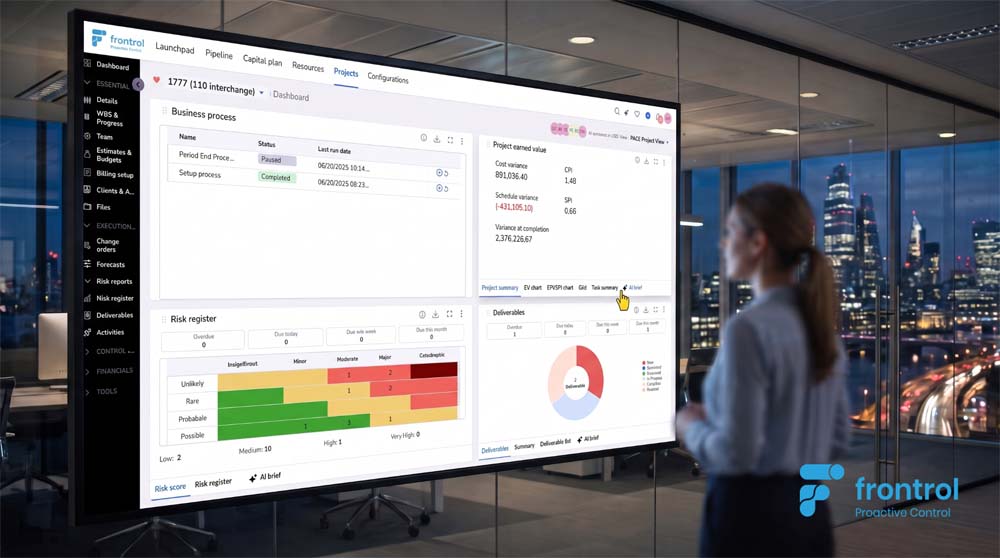
PACE provides regular, consolidated status updates at the program level — covering progress across sub-projects, outstanding risks, key milestones, and benefits realization. For contract programs, dashboards display both cost performance (budget vs. actuals) and revenue performance (billed vs. contracted value), giving leadership a complete financial picture alongside delivery health. These reports ensure strategic decisions are always grounded in current, accurate data without needing to navigate individual project records.
06 — Access & Security
Dedicated Security Functions
Programs in PACE are protected by their own security layer — separate from individual project permissions. Sensitive program-level information (agreements, funding, client data) is visible only to those who need it, while project teams operate within their own scope.
Role | Access Level | Scope |
Program Admin | Full program control | Program |
Program Sponsor | Approve & review | Program |
Program Viewer | Read-only access | Program |
External Auditor | Documents only | Program |
Project Manager | Per-project control | Project |
Team Member | Task-level execution | Project |
Client Contact | Limited project view | Project |
In the LA28 program, the Program Admin is the Program Director. Program Sponsors are the firm’s CEO and CFO, who review financial and milestone reports without accessing individual project task lists. External auditors from the IOC can access program documents — contracts, compliance certificates — but cannot see internal cost data or project-level financials. Each venue’s Project Manager controls their own project scope independently. TWO-LAYER SECURITY Program-level roles (Admin, Sponsor, Viewer, Auditor) wrap around project-level roles (PM, Team Member, Client Contact). The two layers are independent — a team member on a project does not automatically get visibility into program-level documents or financials. |
07 — Document Management
Program-Level Document Folders
Every program gets its own dedicated document folder structure — independent from project documents. This is where program-level artifacts live: master agreements, funding letters, consolidated reports, compliance records, and executive summaries.
Program: Digital Transformation 2025 |– Agreements & Contracts/ | |– Master Service Agreement v2.pdf | |– Funding Authorization Letter.pdf |– Governance/ | |– Program Charter.docx | |– Steering Committee Minutes/ | |– Q1-2025-Minutes.pdf | |– Q2-2025-Minutes.pdf |– Financials/ | |– Program Budget Summary.xlsx | |– Funding Disbursement Schedule.pdf |– Reports/ |– Monthly Status Reports/ |– Executive Dashboard.pptx |
LA28 OLYMPICS EXAMPLE
The LA28 program document library holds the master contract with the LA28 Organizing Committee, IOC compliance certificates, the consolidated program budget workbook, steering committee minutes, and monthly executive dashboards. Individual venue projects hold their own design drawings, subcontractor agreements, and inspection reports — separate from the program library, but visible to the Program Director through the two-layer access model.
This structure is predefined and ready when you create a program — especially when using a program template, which pre-populates standard folder hierarchies, security roles, and initial project structures to get your team running immediately.
08 — Getting Started
Start from a Template
Creating a program from scratch takes time. Program Templates in PACE let you capture institutional knowledge — your standard document structures, security setup, and default project types — and replay them every time you kick off a similar initiative.
WHAT A TEMPLATE INCLUDES A program template can pre-configure folder structure, security role assignments, default budget approach (top-down or bottom-up), standard project stubs, and key agreement placeholders — giving new programs a running start. |
INTERNAL TO PACE, NOT ERP Programs are a PACE-native concept and are not synchronized to your ERP system. This means program-level planning and governance stays flexible and rapid, without ERP change control overhead. When individual projects generate financial actuals, those flow through normal ERP channels independently. |
09 — Conclusion
Good program management isn’t about adding bureaucracy — it’s about creating the right visibility at the right level, so the people who need to make strategic decisions have the information to make them confidently.
PACE Programs bring together team coordination, budgeting strategy, document governance, and access control into a single coherent layer that sits above your projects without disrupting how individual teams work. Whether you’re running a transformation program, a multi-phase client engagement, or a portfolio of product launches — Programs in PACE give you the structure to scale.
“One program. Multiple projects. Full visibility. Zero duplication.”
LA28 OLYMPICS EXAMPLE
For the LA28 program, key program-level deliverables include: completion of all nine venues to IOC specification (revenue deliverable), delivery within the contracted cost envelope (cost deliverable), and a comprehensive program plan showing consolidated progress across all nine projects. The program plan aggregates individual project schedules into a single view — giving the Program Director an at-a-glance picture of overall delivery health without navigating each project separately. Program-level risk identification and mitigation strategies are a further key deliverable: these include risks cutting across all projects such as city-level planning approvals and permits that affect multiple venues simultaneously, revenue-sharing agreement compliance with the LA28 Organizing Committee, and supply chain risks (e.g. a concrete shortage impacting the Athlete Village and Athletics Stadium in parallel). Each identified risk is logged in the program risk register with an assigned owner, likelihood rating, impact assessment, and mitigation action — ensuring nothing falls through the gaps between projects. Monthly program dashboards show consolidated cost burn across all nine projects alongside billed vs. contracted revenue, giving the client and the board a single view of financial and delivery health.