Capital programs have become far more complex than they were years ago. Owners are now managing projects funded through a mix of federal, state, local, and bond dollars, often across dozens of concurrent projects, delivery models, and stakeholders. Even with that complexity, many are still relying on PMIS platforms built to manage documentation and workflow at the individual project level, not to govern a multi-funded portfolio.
Existing PMIS did not get worse, but the demands of capital project management outgrew what a document-and-workflow system was ever designed to carry.
As portfolios grow, leadership needs answers beyond the status of a single project. They need to understand which projects are at risk, what’s driving delays or cost exposure, how those issues affect the wider capital program, and where to focus attention first. That’s the gap pushing more capital owners to look beyond the traditional PMIS.
In This Guide:
- What a Project Management Information System (PMIS) Was Built to Do
- Why Capital Portfolios Need Governance Beyond a PMIS
- What a Capital Program Actually Needs Instead
- Governance Starts with Connected Project Data
- Frequently Asked Questions on Capital Project Management
What PMIS Was Built to Do
A Project Management Information System (PMIS) plays an important role in capital project delivery. It tracks the lifecycle of project documents, routes approvals, timestamps correspondence, and keeps a complete record of project activity. It’s particularly valuable for public capital programs where every decision can trigger an audit or a records request.
The challenge is that today’s capital programs demand more than a historical record. There is now a need to connect that documentation to cost, schedule, forecast, funding, and risk in a way that produces a forward-looking view of program health. A PMIS can tell you a change order was submitted on a given date, but it’s much less equipped to tell you what that change means for the estimate at completion across different funding sources.
That distinction becomes more important as capital portfolios grow. A five-project program can survive on documentation discipline alone. But a capital program spanning federal, state, local, bond, and internal funding, running across dozens of active projects and several delivery models, needs something that behaves less like a filing system and more like a project delivery execution platform. It requires one that connects funding, cost, schedule, risk, and change into a single view of where the portfolio actually stands.
Why Capital Portfolios Need Governance Beyond a PMIS
Tracking and governance may sound similar, but they serve different purposes.
Tracking tells you where a project stands today. Governance helps ensure the right decisions are made when that status changes. It defines who needs to be notified, what approvals are required, how funding is affected, and whether forecasts are updated before a small issue becomes a larger problem.
A single project can often run on tracking alone, but a capital portfolio cannot. As portfolios grow, the difference between tracking and governance becomes much more visible.
- Funding Gets Harder to Manage
A project funded from one capital budget is simple to track. A program funded through federal grants, state funding, local bonds, and internal capital is not. Each source carries its own reporting rules, eligible-cost definitions, and deadlines. A PMIS captures the documentation but it doesn’t manage the funding. That gap is why teams end up reconciling by hand in spreadsheets.
Example: A transportation project might draw $12M from a federal formula grant, $4M from a state bond, and $3M from internal capital. The federal dollars carry strict eligibility rules and quarterly draw deadlines. The bond funding follows its own milestone-based reimbursement schedule. Code $500K of a change order to the wrong funding source, and the problem may not surface until the next reimbursement request, compliance review, or audit. That’s usually long after the work is complete.
- Audit Readiness Becomes More Difficult
When an auditor asks how a decision was made, the answer will naturally require pulling records from different sources. Project records may be in the PMIS, financial data in the ERP, and change history in another application or spreadsheet. Teams have to bring that information together manually to recreate the full story because those systems were never designed to govern the portfolio as one connected environment.
- Portfolio-Level Questions Take Longer to Answer
In reality, executives aren’t looking for the status of a single project. They want to know which ones need attention, what’s driving the risk, and where intervention will have the greatest impact.
Answering those questions often means pulling status from individual project teams, reviewing forecast changes, and comparing information across multiple systems. By the time that work is done, the portfolio may have already changed.
- Governance Relies on People Instead of the Process
Change control, funding approvals, and risk escalation often exist as procedures documented in a binder somewhere. The challenge is making sure they’re followed consistently across every project.
A PMIS can store the approved change order once it’s signed. However, governance also requires making sure all the right people are informed, funding impacts are understood, and decisions are reflected across the portfolio before risks continue to grow.
What a Capital Program Actually Needs Instead
Organizations that move beyond a traditional PMIS usually aren’t looking for a bigger document management system. They’re looking for a platform that brings funding, cost, schedule, risk, and change together into one connected view instead of managing each in separate systems tied together with spreadsheets.
That means a platform that can:
- Track multiple funding sources within the same project or program, including allocations, drawdowns, eligible costs, and reporting requirements for each source.
- Show which projects are driving portfolio-level cost or schedule variance without requiring teams to manually consolidate data.
- Connect risk and change directly to forecast and funding impacts instead of managing them in separate logs.
- Create an audit trail as part of the way work is approved and managed, rather than requiring teams to reconstruct decisions after the fact.
- Give executives a current view of what needs attention today instead of relying on reports that are already out of date.
This is the difference between a system that documents a capital program and one that helps govern it. A project delivery execution platform helps owners understand what’s changing, where the portfolio is exposed, and what action to take next. That’s what capital project management requires as programs grow in size, complexity, and accountability.
That shift is changing how many owner organizations think about their technology stack. Instead of expecting one system to do everything, they’re connecting their existing systems of record with a platform designed to manage project delivery across the entire capital portfolio. PACE is built around exactly that model to connect cost, schedule, funding, forecasting, risk, and change into a single project delivery environment, without displacing the systems teams already rely on.
Governance Starts with Connected Project Data
A PMIS gives owners a reliable record of what happened, but managing a capital portfolio requires more than looking backward.
When funding changes, a schedule slips, or a major change order is approved, leadership needs to understand what that means for the rest of the program. It needs to answer:
- Which funding sources are affected?
- Does the forecast change?
- Are other projects now at risk?
- Can action still be taken before the impact grows?
You don’t get those answers by generating another report. You get them when funding, cost, schedule, forecasting, risk, and change all live in the same environment, and everyone has a shared view of what’s happening across the portfolio.
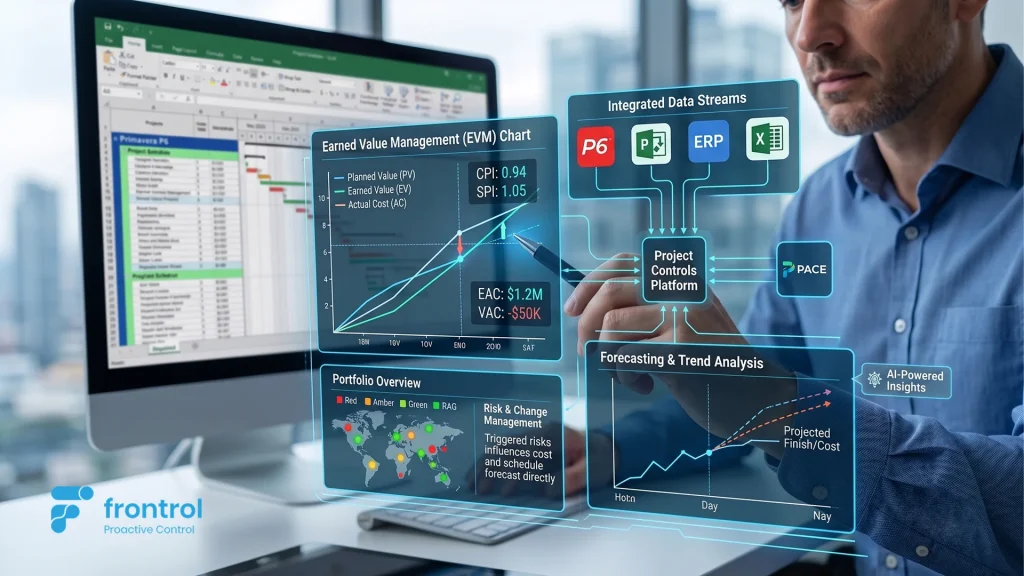
PACE is a project delivery execution platform designed specifically for capital programs. It connects project controls, funding, forecasting, earned value, risk, change, and portfolio performance into a single governed environment. Owners get a current view of what’s happening across their programs, instead of piecing it together from multiple systems.
Existing ERP, PMIS, and funding systems keep doing what they already do well while PACE connects the information, creating a shared operational view of where the portfolio stands today and where attention is needed next. The team behind PACE built it out of direct experience running capital programs and enterprise software implementations. That’s why it’s built around real-time visibility and proactive control rather than retrospective reporting.
Owners using PACE don’t usually talk about better dashboards. They talk about getting time back. Reporting that used to take days is done in hours, and audit prep no longer means digging through email threads to piece together decisions. The record is already there.
For organizations weighing what comes after a traditional PMIS, dashboard count isn’t the metric that matters. The platform that matters is the one that gets your team to the risk sooner, gets a defensible decision made faster, and keeps the program moving instead of stuck explaining itself.
Frequently Asked Questions (FAQs)
- Does moving beyond PMIS mean replacing it entirely?
Not necessarily. Many owner organizations keep their existing PMIS in place for document control and workflow while adding a connected layer that brings funding, cost, schedule, risk, and change together above it. The PMIS can remain the system of record for documentation; it simply stops being asked to do portfolio-level governance work it wasn’t designed for.
- Is this only relevant for large or multi-billion-dollar capital programs?
No. The need usually appears once an organization is managing multiple active projects, several funding sources, or stricter reporting and compliance requirements. That includes many regional agencies, municipalities, and utilities, not just billion-dollar programs.
- How is this different from just adding a business intelligence dashboard on top of the existing systems?
A business intelligence dashboard helps visualize data from other systems, but it does not manage other processes. Funding, approvals, change control, and risk still happen elsewhere. A connected capital execution platform brings those processes into one environment, so reporting reflects what’s happening in real time instead of relying on manually assembled snapshots.
- What’s the realistic first step for an owner organization considering this?
Most organizations don’t fully replace every existing tool at once. They start with an area causing the most manual pain like funding reconciliation or portfolio-level reporting and expand from there. This phased approach lets the organization prove value on the highest-friction problem before expanding into broader forecasting, risk, and change capabilities.
- How does a connected platform affect audits?
It does not eliminate audits, but it makes preparing for them much easier. Rather than reconstructing decisions from emails, spreadsheets, and PMIS records after a request comes in, the supporting history (approvals, funding movements, changes) already exists in a traceable form as a byproduct of how the program runs day to day.
See Connected Project Controls in Action
PACE was built by people who spent years inside capital-intensive delivery and enterprise software. We saw firsthand where fragmented systems and disconnected spreadsheets were putting capital programs at risk. That experience is why PACE now runs across 70+ countries, supports 26,000+ active users, and holds a 98% user satisfaction rate among the owners and delivery teams who rely on it.
It brings funding, cost, schedule, risk, and change into one governed view, so organizations can identify where a program is exposed while there’s still time to intervene.
Schedule a demonstration with Frontrol to see how PACE supports capital project management across complex and multi-funded programs.