PROGRAM MANAGEMENT
Program Governance in PACE: Risk, Documents, Access Control, and Templates
The operational layer that keeps complex multi-project programs running predictably – from risk registers to document governance and repeatable program templates.
Structure and budget control establish the foundation of a well-run program. But the day-to-day reality of complex multi-project delivery depends on something equally important: the governance layer that keeps risks visible, documents organized, access controlled, and new programs launching without starting from scratch.
This is the second of two posts on PACE Program Management. The first covered program structure, hierarchy, and budgeting. This one covers what happens once the program is running – and what PACE provides to keep it running well.
Deliverables and Risk Management
Program-level deliverables in PACE are broader and more strategic than at the project level. They focus on outcomes, benefits, and cross-project alignment – not individual task completion.
For contract programs, deliverables span both dimensions that matter: what has been committed to clients (revenue deliverables) and what is required to deliver it (cost deliverables). Both are tracked in the same environment, giving program managers a complete picture of financial and delivery health.
Cross-Project Risk Visibility
PACE supports program-level risk management through a unified risk register that captures risks cutting across multiple projects – the risks that fall through the gaps when each project team manages risk in isolation.
For contract programs specifically, this includes both delivery risks (cost overruns, schedule slippage affecting multiple workstreams) and commercial risks (revenue shortfall, contract non-compliance). Each risk is logged with an assigned owner, likelihood rating, impact assessment, and mitigation action.
The result is that program managers can see and act on cross-project risk before it escalates – not after it has already affected multiple workstreams simultaneously.
LA28 OLYMPICS – IN PRACTICE
For the LA28 program, key program-level deliverables include completion of all nine venues to IOC specification, delivery within the contracted cost envelope, and a consolidated program plan showing overall delivery health.
Program-level risks include city planning approvals and permits affecting multiple venues simultaneously, revenue-sharing compliance with the LA28 Organizing Committee, and supply chain risks such as a concrete shortage impacting both the Athlete Village and Athletics Stadium in parallel. Each risk is logged in the program risk register – not buried inside individual project files where it would be invisible to the Program Director.
06 Status Reports and Program Dashboards
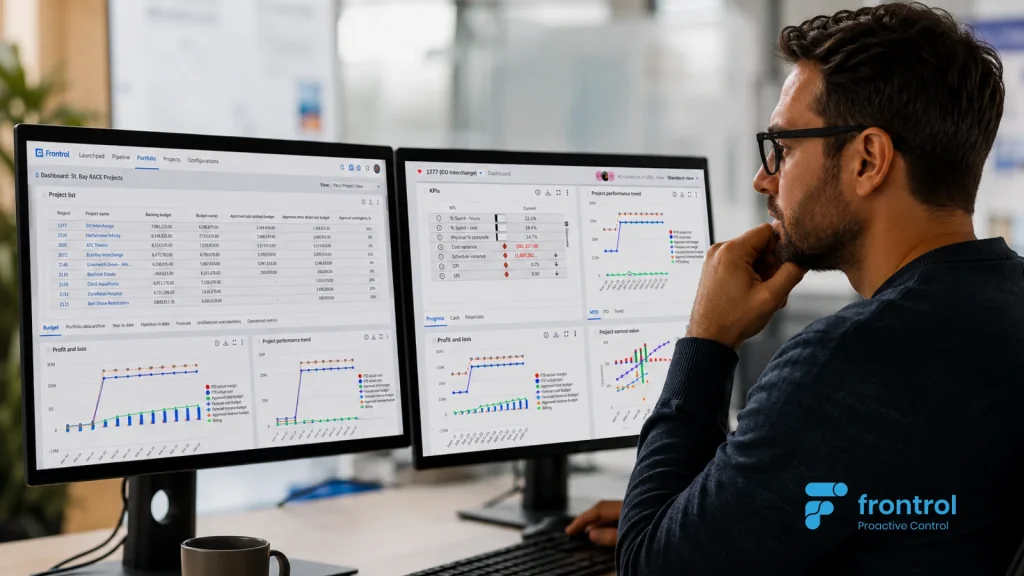
PACE generates consolidated program-level status updates that cover progress across all sub-projects, outstanding risks, key milestones, and benefits realization – without requiring manual aggregation from individual project managers.
For contract programs, dashboards display cost performance (budget versus actuals) and revenue performance (billed versus contracted value) side by side, giving leadership a complete financial picture alongside delivery health. These are live – not assembled from reports submitted the previous week.
The practical outcome is that strategic decisions are always grounded in current data. A Program Director preparing for a steering committee meeting works from the same live dashboard that reflects this morning’s activity – not a consolidated report that was accurate three days ago.
LA28 OLYMPICS – IN PRACTICE
Monthly program dashboards for LA28 show consolidated cost burn across all nine projects alongside billed versus contracted revenue, giving both the client and the board a single view of financial and delivery health. The Program Director does not navigate each of the nine project records individually – the program dashboard surfaces everything that needs attention in one place.
07 Access Control and Security
Programs in PACE operate with their own dedicated security layer – separate from individual project permissions. This matters because program-level information is often more sensitive than project-level data: master agreements, consolidated financials, client data, and funding letters need to be visible to the right people without being accessible to every member of every project team.
PACE handles this through a two-layer access model.
Program-level roles control who can see and edit program-level records.
Project-level roles control access within each individual project.
The two layers are independent, which means a project manager can have full access to their own project without seeing sensitive program-level commercial information – and a Program Director can see everything without project teams having elevated access.
For organizations managing multiple client engagements, regulated programs, or commercially sensitive contract data, this is not a minor feature. It is what makes it operationally safe to run the entire program portfolio in a single environment.
08 Program-Level Document Management
Every program in PACE gets its own dedicated document folder structure, independent from project documents. This is where program-level artifacts live:
master agreements, funding letters, consolidated reports, compliance records, and executive summaries.
Project documents – design drawings, subcontractor agreements, inspection reports – live in their own project-level folders.
Both layers are accessible to the Program Director through the two-layer access model, but they are kept structurally separate so program governance documents are never buried among project-level files.
This folder structure is predefined and ready when a program is created – particularly when using a program template, which pre-populates standard folder hierarchies, security roles, and initial project structures so teams can start working immediately.
LA28 OLYMPICS – IN PRACTICE
The LA28 program document library holds the master contract with the LA28 Organizing Committee, IOC compliance certificates, the consolidated program budget, steering committee minutes, and monthly executive dashboards. Individual venue projects hold their own design drawings, subcontractor agreements, and inspection reports – separate from the program library, but fully visible to the Program Director.
09 Program Templates and Getting Started
Creating a program from scratch takes time.
Program Templates in PACE capture institutional knowledge – standard document structures, security configurations, and default project types – and replay them every time a similar initiative launches.
For organizations that run recurring program types (infrastructure contracts, multi-phase product launches, annual capital programs), templates eliminate the setup overhead and ensure that every program starts with the same governance standards already in place. New team members inherit the structure rather than spending weeks learning how the organization wants things organized.
The practical benefit is consistency at scale: programs launched six months apart look and operate the same way, use the same folder hierarchies, and apply the same security configurations – regardless of who set them up.
10 What Good Program Management Delivers
Taken together, the capabilities covered across these two posts translate into outcomes that are measurable in how programs actually run.
- Cross-project risks stay visible. Program-level risk registers surface risks that would otherwise be invisible in individual project files, giving program managers the ability to act before issues cascade.
- Leadership always has current data. Live dashboards replace manually assembled status reports, so strategic decisions are made on information that reflects today – not last week.
- Sensitive information stays protected. The two-layer access model means programs can run in a shared environment without commercial or contractual data being exposed to project-level teams.
- New programs launch faster. Templates capture institutional knowledge and eliminate setup overhead, so teams are running on the right governance structure from day one.
Good program management isn’t about adding bureaucracy. It’s about creating the right visibility at the right level, so the people who need to make strategic decisions have the information to make them confidently.
PACE Programs bring together team coordination, budget governance, document management, risk visibility, and access control into a single coherent layer that sits above your projects without disrupting how individual teams work. Whether you’re running a transformation program, a multi-phase contract engagement, or a portfolio of capital initiatives – Programs in PACE give you the structure to scale.
Explore PACE Program Management → frontrol.com