Stop Managing Projects. Start Managing Knowledge.
When most organizations look for Project Management software, they are looking for a container—a place to put tasks, deadlines, and Gantt charts. They are looking for a way to answer the question: “Who is doing what, and when will it be done?”
But with PACE, we believe that is setting the bar too low.
If your software only tracks current tasks, you are missing the most valuable asset your company generates every day: Experience.
What happens when your best Project Manager leaves? What happens when you acquire a new entity and need to integrate their team? What happens when you hire ten new contractors who don’t know your Standard Operating Procedures (SOPs)?
Usually, chaos ensues. Knowledge walks out the door, and new hires waste months reinventing the wheel.
We built PACE not just to manage projects, but to institutionalize your knowledge base. We designed it to capture your organization’s unique “Ways of Working,” ensuring that your process is scalable, repeatable, and independent of any single individual.
Here is how PACE turns your project management process into a legacy of success.
- The Template Engine: Your Baseline for Excellence
The biggest risk in project execution is the “blank page.” When a Project Manager starts a new initiative from scratch, they are relying entirely on their own memory to list tasks, estimate durations, and sequence dependencies.
PACE solves this by allowing you to crystallize organizational experience into Project Templates.
This is more than just a copy-paste feature. It allows you to embed the DNA of a successful project into the system. You can pre-define all necessary tasks, their indicative durations, and the critical path for various project types.
- For New Joiners: A new PM doesn’t need to guess how your company executes an “engineering engagement” or a “Construction Phase.” They simply load the template. They immediately see the roadmap, ensuring they don’t miss minor but critical details.
- Compliance: By using the template, the user is automatically compliant with your agreed SOPs.
- The Risk Assessment questionnaire and Risk Library: Institutionalizing “Defensive Wisdom”
One of the hardest skills to teach a new Project Manager is risk anticipation. Junior managers often don’t see the iceberg until the ship hits it.
PACE allows you to build a comprehensive Risk Library and a Risk Assessment Questionnaire. This is a centralized repository of all potential risks that may or may not have materialized on past performed work and that may occur in the future, based on your organization’s collective history.
When a manager starts a new project, they don’t have to brainstorm risks in a vacuum. The assessment questionnaire guides them with a simple question and answer format to help identify risks that they may face with their project. They can also access the Risk Library and import applicable risks directly into their current project’s Risk Register.
- Triggered Thinking: The assessment questionnaire and the library act as prompts. A PM might see a risk listed regarding “Vendor Insolvency” and realize they haven’t checked their supplier’s health.
- Standardized Mitigation: You don’t just import the risk; you import the standard mitigation plan. This ensures that even a rookie PM handles a crisis with the wisdom of a veteran.
- Pre-Defined Process Flows: Following a standardized process
Knowing all the steps that need to be completed for various project processes be they the month end process or a change order process or the project end process. PACE enables “ Business Processes” that provide a step by step guidance on the elements to be completed for a particular projects process. For example, the Month End process for a project could look something like this: 
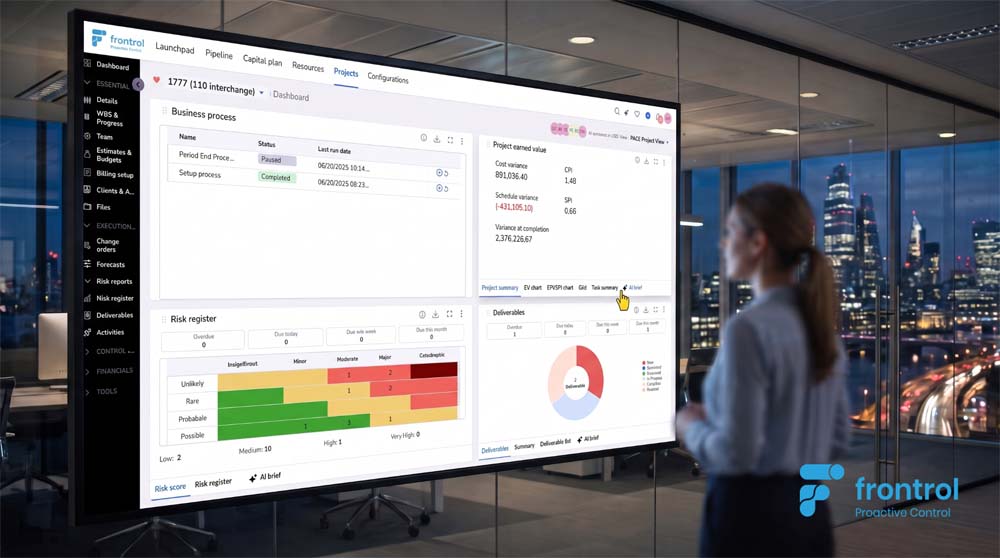
All the PM needs to do is initiate the process from the project dashboard and pace will walk them through every step of the way.
- Standardized Status Reporting: Speaking the Same Language
One of the steepest learning curves for any new hire—or a newly acquired team—is understanding how to communicate with organization management. What details matter? What is the preferred format?
PACE eliminates this friction by encapsulating your organization’s standard reporting structure directly into the workflow.
The system presents the user with pre-defined reporting sections that mirror exactly what your management and finance teams expects to see. Whether it’s “Key Decisions Needed,” “Risk Highlights,” or “Budget Variance,” the format is locked in.
Why this matters:
- Instant Alignment: A Project Manager from a recently acquired company doesn’t need to unlearn their old habits or guess at your preferences. They simply fill in the sections provided.
- Time Savings: It removes the drafting anxiety and formatting hours. The “Status Report” becomes a fill-in-the-blanks exercise based on institutional best practices, not a creative writing assignment.
- The Feedback Loop: Turning Closure into Capability
A template is only as good as its relevance. In many organizations, “Lessons Learned” sessions happen at the end of a project, are written in a Word document, stored on a shared drive, and never looked at again.
PACE operationalizes this learning.
We encourage users to customize the Project Closure Checklist. You can mandate a closure step that says: “Based on this project’s execution, work with the PMO to review and update the Master Template.”
Did a specific task take three weeks instead of the planned one week? Did a new regulatory requirement pop up? By forcing this review within the workflow, the “Project Closure” phase becomes the engine for updating the organization’s knowledge base.
The Big Picture: Change Management & Scaling
There are numerous ways to capture your learnings in PACE, but the ultimate goal is scalability.
Scaling Teams: When you hire a wave of new contract managers or team members, you cannot afford a six-month learning curve. With PACE, the process is the product. As long as they can log in and follow the workflow, they are executing at 80% of the efficiency of a tenured employee from Day 1.
Mergers & Acquisitions: When you acquire a new entity, the hardest part is cultural integration and harmonizing processes. PACE bridges this gap. By migrating the new entity onto the platform, you aren’t just giving them a tool; you are handing them the playbook for how your organization succeeds.
Conclusion
Project management software shouldn’t just be a scorecard of what you are doing today. It should be a vault for what you learned yesterday, and a guide for how you will succeed tomorrow.
Stop relying on tribal knowledge that lives in people’s heads. Start institutionalizing your success.